Title: "Becoming Naomi Leon"
Author: Pam Munoz Ryan
Publisher: Scholastic, Inc., 2004
Genre: Multi-cultural Novel
Grade: 4-5
This book begins with Naomi Outlaw, a fifth grade girl who is made fun of for her last name. She is teased by everyone at school because they ask her if she had stolen anything today? Naomi and Owen live with their great-grandmother, Gram, because their real mother had left them with Gram seven years ago. Then one day their world was turned upside down when their mother, Skyla, shows up on ther doorstep. Skyla thinks that she has every right to be their mother and do motherly things like go to their parent teacher conferences. Naomi had arranged for her new friend Blanca's mother to meet Skyla but Skyla never shows. Skyla wants to take Naomi with her and her boyfriend, Clive, to Las Vegas, but Naomi insists she is not going anywhere without Gram and Owen. Gram then takes Owen and Naomi to Mexico to try and find their father so he can write a recommendation for the children to be left with Gram. When they find him, there is an instant connection. When they leave Mexico, Santiago, their father, says he would love to see the kids over the summer if Gram would allow it. When they get back to Lemon Tree, California they go to court to see if Gram or Skyla will get custody. Gram ends up getting custody because Naomi tells the truth about Skyla and the beer and slapping her.
I really enjoyed this book. I thought it was a great multicultural book about Mexican-Americans. I liked how it included cultural markers throughout the book. The Night of the Radishes was something that a lot of families did because it had been something that generations upon generations had done. Bunuelos are a traditional Western dish that is served at the Night of the Radishes. The family being as close as they were was another thing that played a role in Mexican culture. I think that the author does present an insider's perspective. The Author's Note in the back says that Ryan has background in the Mexican culture. It also says that she went to the Night of the Radishes to experience what that would really be like. I thought this book reminded me a lot of Opal in "Because of Winn Dixie" because of the way they both lived in trailer parks but had no one their age living there with them. Neither had a mother in their lives, however Naomi had a great-grandmother who was her mother figure. Opal and Naomi both had older influences on their lives because they hung out with the older people in their lives. There were also superstitions in both books. Opal became friends with the older lady who had bottles hanging from her tree to keep the bad thing away, while Gram had all these superstitions about writing down things they really wanted to come true. I couldn't believe how their mother acted though. There is no way that she was even fit to be a mother because she didn't even want Owen because he had all these problems and the only reason she wanted Naomi was to babysit Sapphire.
I would definitely use this book in an older elementary to middle school aged classroom. I would have my students to keep a journal much like Naomi's. They could make lists of "Splendid Words" and things that they know about certain things. They could also pick a place they would like to go and write in their journal about that trip to, from, and while they were there.
Sunday, April 27, 2008

Tuesday, April 22, 2008
"The Breadwinner"
Title: "The Breadwinner"
Author: Deborah Ellis
Illustrator: Pascal Milelli
Publisher: Groundwood Books, 2000
Genre: multicultural novel
Grade: 4-5
Parvana, who is an eleven year old Afghan girl, lives in Afghanistan which has recently been taken over by the Taliban. Females are not allowed to go out of the house without a male escort or a piece of paper giving them permission from a male to be out. It was so bad in Afghanistan that they didn't believe that girls should receive an education, so Parvana and her sisters had to drop out of school. One day the Taliban came to the house and arrested their father. Parvana and her Mother go the next day to find out something about Parvana's father, but they won't tell them anything. Mrs. Weera and Mother decide that Parvana should cut her hair and dress like a boy and work at the market to make some money for the family to eat on. Eventually Mrs. Weera ends up moving in to the house with Parvana's family. Nooria, Parvana's older sister, becomes engaged so the family leaves for Mazar and leaves Parvana with Mrs. Weera. Parvana begins to worry when she gets word that Mazar has been taken by the Taliban. Father is released from prison and Father and Parvana go to the refugee camps to try to find Mother, Nooria, Maryam, and Ali.
I liked this book. It was slow moving in the beginning but once I got into it, it became a book I could not put down. I had no idea that this is how it is over in Afghanistan. I could not imagine not being able to go out whenever I wanted because I didn't have a male escort. I also couldn't believe that the Taliban did not want any Afghan girls getting an education. I really thought Ellis did a great job describing what was going on in Afghanistan. I also thought that the scene where Ellis describes the soccer game, however it is not a real soccer game but rather a place where the Taliban soldiers took prisoners to and cut off their hands.
I would use this book in my classroom one day in a multicultural unit or in an Afghanistan/ War in Iraq unit. I would have the students to read the book and keep a journal of what they read and how they feel about what they read in each chapter. We could also do a venn diagram or something to compare the way the Afghan male treatment compares to the treatment of Afghan females.
Author: Deborah Ellis
Illustrator: Pascal Milelli
Publisher: Groundwood Books, 2000
Genre: multicultural novel
Grade: 4-5
Parvana, who is an eleven year old Afghan girl, lives in Afghanistan which has recently been taken over by the Taliban. Females are not allowed to go out of the house without a male escort or a piece of paper giving them permission from a male to be out. It was so bad in Afghanistan that they didn't believe that girls should receive an education, so Parvana and her sisters had to drop out of school. One day the Taliban came to the house and arrested their father. Parvana and her Mother go the next day to find out something about Parvana's father, but they won't tell them anything. Mrs. Weera and Mother decide that Parvana should cut her hair and dress like a boy and work at the market to make some money for the family to eat on. Eventually Mrs. Weera ends up moving in to the house with Parvana's family. Nooria, Parvana's older sister, becomes engaged so the family leaves for Mazar and leaves Parvana with Mrs. Weera. Parvana begins to worry when she gets word that Mazar has been taken by the Taliban. Father is released from prison and Father and Parvana go to the refugee camps to try to find Mother, Nooria, Maryam, and Ali.
I liked this book. It was slow moving in the beginning but once I got into it, it became a book I could not put down. I had no idea that this is how it is over in Afghanistan. I could not imagine not being able to go out whenever I wanted because I didn't have a male escort. I also couldn't believe that the Taliban did not want any Afghan girls getting an education. I really thought Ellis did a great job describing what was going on in Afghanistan. I also thought that the scene where Ellis describes the soccer game, however it is not a real soccer game but rather a place where the Taliban soldiers took prisoners to and cut off their hands.
I would use this book in my classroom one day in a multicultural unit or in an Afghanistan/ War in Iraq unit. I would have the students to read the book and keep a journal of what they read and how they feel about what they read in each chapter. We could also do a venn diagram or something to compare the way the Afghan male treatment compares to the treatment of Afghan females.
Monday, April 21, 2008
"Behold the Bold Umbrellaphant and Other Poems"
Title: "Behold the Bold Umbrellaphant and Other Poems"
Author: Jack Prelutsky
Illustrator: Carin Berger
Publisher: Greenwillow Books, 2006
Genre: Children's Poetry
Grade: 2-3
"The Trumpetoos and Tubaboons"
The TRUMPETOOS and TUBABOONS
are blaring out discordant tunes.
They play them loud, they play them long,
But most of all, they play them wrong.
They open up their brazen throats,
unleashing a barrage of notes
That would be better left unplayed....
Bt play they do as they parade.
Their sounds are jarring to the ear,
As noisily they persevere
And play in clashing beats and keys
Unmusical cacophonies.
They march about in close array.
We wish they'd simply march away.
Or stop and take a silent snooze------
Those TUBABOONS and TRUMPETOOS.
I really enjoyed this poem because it was about music. I've always loved the brass sound that tubas and trumpets make. My brother actually plays the tuba which made this poem even better. I loved the imagery that one gets from reading this poem. It's like I can actually see and hear these instruments playing these awful sounds and marching around! I also love the adjectives in this poem, such as brazen and discordant tunes. I would definitely use this book in my class. I love how it takes different animals and adds the animal to an everyday object and makes the poem based on the new object. I would use this book to read it to my students and then have them to draw a picture representing what they think these objects would look like and what actions they would be doing. The illustrations in this particular book were done by making collages on different types of paper. I loved the way the illustrations had different backgrounds.
Sound was a big part of this poem. They blare and play them loud, but play them wrong! The rhythm in this poem seems to be like that of a marching band because they march around playing the wrong notes. In the stanzas the first and second lines rhyme and then the third and fourth rhyme. So it follows an AABB pattern. There aren't really any alliteration or onomatopoeia in this poem. The images in this poem are amazing because without even looking at the pictures I can see the instruments marching around and how offbalance and off kilter they are since they play the wrong notes.
Author: Jack Prelutsky
Illustrator: Carin Berger
Publisher: Greenwillow Books, 2006
Genre: Children's Poetry
Grade: 2-3
"The Trumpetoos and Tubaboons"
The TRUMPETOOS and TUBABOONS
are blaring out discordant tunes.
They play them loud, they play them long,
But most of all, they play them wrong.
They open up their brazen throats,
unleashing a barrage of notes
That would be better left unplayed....
Bt play they do as they parade.
Their sounds are jarring to the ear,
As noisily they persevere
And play in clashing beats and keys
Unmusical cacophonies.
They march about in close array.
We wish they'd simply march away.
Or stop and take a silent snooze------
Those TUBABOONS and TRUMPETOOS.
I really enjoyed this poem because it was about music. I've always loved the brass sound that tubas and trumpets make. My brother actually plays the tuba which made this poem even better. I loved the imagery that one gets from reading this poem. It's like I can actually see and hear these instruments playing these awful sounds and marching around! I also love the adjectives in this poem, such as brazen and discordant tunes. I would definitely use this book in my class. I love how it takes different animals and adds the animal to an everyday object and makes the poem based on the new object. I would use this book to read it to my students and then have them to draw a picture representing what they think these objects would look like and what actions they would be doing. The illustrations in this particular book were done by making collages on different types of paper. I loved the way the illustrations had different backgrounds.
Sound was a big part of this poem. They blare and play them loud, but play them wrong! The rhythm in this poem seems to be like that of a marching band because they march around playing the wrong notes. In the stanzas the first and second lines rhyme and then the third and fourth rhyme. So it follows an AABB pattern. There aren't really any alliteration or onomatopoeia in this poem. The images in this poem are amazing because without even looking at the pictures I can see the instruments marching around and how offbalance and off kilter they are since they play the wrong notes.
Monday, April 14, 2008
Charlie and the Chocolate Factory
Title: "Charlie and the Chocolate Factory"
Author: Roald Dahl
Illustrator: Joseph Schindelman
Publisher: Alfred A. Knopf, Inc., 1964
Grade: 4-5 grade
Genre: fantasy, novel
Charlie lives in a small, two room house with his mother and father and each of their parents. Needless to say that this family was very poor. One day the paper announces that Willy Wonka will open his factory to five lucky people and their guest so they can see the factory and all the things that go on in there. The first two tickets were found by Augustus Gloop, an enormous, nine year old boy, and Veruca Salt, an obnoxious, rich, snobby little girl. On Charlie's birthday his family gives him a candy bar and everyone holds their breath as Charlie opens the chocolate bar, but is disappointed when there was no golden tickets. The third ticket was found by Violet Beauregarde, a gumchewer who talked very fast, and then the fourth ticket was found by Mike Teavee, a boy who constantly watched television. Grandpa Joe wanted Charlie to find that ticket so badly that he gave Charlie ten cents to go buy a candy bar. One day while Charlie is on his way home, he finds a dollar bill on the street and takes that a buys two candy bars and is going to take the remaining 80 cents back to his mother. When he opens the second candy bar, he finds the last golden ticket. Grandpa Joe was Charlie's guest that he took with him. When the ten people get into the factory they are supposed to follow all of Wonka's rules and instructions or something bad will happen. Augustus Gloop falls into the chocolate rivers and gets stuck in the pipe so now there are only four winners left. When the guests go to the invention room, Violet tries some gum that Wonka told her not to and then she starts to turn blue and get really big. She has to leave so now their are three winners left. Next they go to the Nut Room where a machine sorts out the good nuts from the bad. Veruca Salt sits on the scale and is sent down the bad nut shoot. Then there were two. They then went to the Television-Chocolate Room. In this room Mike is turned into a million little pieces. Then there was only Charlie and Grandpa Joe left. All five winners got a lifetime's supply of chocolate but Charlie won the whole thing. When Charlie is old enough to run the chocolate factory, it will become his!
I love Charlie and the Chocolate Factory. I love the old version of the movie. I love how Charlie was the poorest of them all but because he listened to Willy Wonka he ended up the richest of them all because he got the chocolate factory. I loved how all the bad things happened to the others because they didn't listen. They were actually annoying. I think Roald Dahl is an amazing author. He is so descriptive in his work and he writes to wear it feels as though the reader is right there with the characters. For instance when Augustus falls into the river, I felt like I was there worrying with the rest of them. I couldn't stand Veruca Salt because she wanted everything! She was a spoiled rotten little brat!
I would definitely use this book in my classroom. I think that it would be a great book to do character maps and journals with. I could also let my students read the book and then watch the original movie and have them to do a venn-diagram comparing the two.
Author: Roald Dahl
Illustrator: Joseph Schindelman
Publisher: Alfred A. Knopf, Inc., 1964
Grade: 4-5 grade
Genre: fantasy, novel
Charlie lives in a small, two room house with his mother and father and each of their parents. Needless to say that this family was very poor. One day the paper announces that Willy Wonka will open his factory to five lucky people and their guest so they can see the factory and all the things that go on in there. The first two tickets were found by Augustus Gloop, an enormous, nine year old boy, and Veruca Salt, an obnoxious, rich, snobby little girl. On Charlie's birthday his family gives him a candy bar and everyone holds their breath as Charlie opens the chocolate bar, but is disappointed when there was no golden tickets. The third ticket was found by Violet Beauregarde, a gumchewer who talked very fast, and then the fourth ticket was found by Mike Teavee, a boy who constantly watched television. Grandpa Joe wanted Charlie to find that ticket so badly that he gave Charlie ten cents to go buy a candy bar. One day while Charlie is on his way home, he finds a dollar bill on the street and takes that a buys two candy bars and is going to take the remaining 80 cents back to his mother. When he opens the second candy bar, he finds the last golden ticket. Grandpa Joe was Charlie's guest that he took with him. When the ten people get into the factory they are supposed to follow all of Wonka's rules and instructions or something bad will happen. Augustus Gloop falls into the chocolate rivers and gets stuck in the pipe so now there are only four winners left. When the guests go to the invention room, Violet tries some gum that Wonka told her not to and then she starts to turn blue and get really big. She has to leave so now their are three winners left. Next they go to the Nut Room where a machine sorts out the good nuts from the bad. Veruca Salt sits on the scale and is sent down the bad nut shoot. Then there were two. They then went to the Television-Chocolate Room. In this room Mike is turned into a million little pieces. Then there was only Charlie and Grandpa Joe left. All five winners got a lifetime's supply of chocolate but Charlie won the whole thing. When Charlie is old enough to run the chocolate factory, it will become his!
I love Charlie and the Chocolate Factory. I love the old version of the movie. I love how Charlie was the poorest of them all but because he listened to Willy Wonka he ended up the richest of them all because he got the chocolate factory. I loved how all the bad things happened to the others because they didn't listen. They were actually annoying. I think Roald Dahl is an amazing author. He is so descriptive in his work and he writes to wear it feels as though the reader is right there with the characters. For instance when Augustus falls into the river, I felt like I was there worrying with the rest of them. I couldn't stand Veruca Salt because she wanted everything! She was a spoiled rotten little brat!
I would definitely use this book in my classroom. I think that it would be a great book to do character maps and journals with. I could also let my students read the book and then watch the original movie and have them to do a venn-diagram comparing the two.
Number the Stars
Title: "Number the Stars"
Author: Lois Lowry
Publisher: Yearling Books. 1989
Grade: 4th-5th
Genre: historical fiction novel
The story begins with with Annemarie and her friend Ellen, who is a Jew, who are racing down the street and they are stopped by some Nazis. A little while later, Ellen is forced to come and stay with Annemarie and her family, because the Rosens had to leave with Peter to escape being sent away since they were Jewish. That same night soldiers come searching for the Rosens and when they don't find them they come to the Johansen's apartment. They search the whole apartment and eventually come into the bedroom where Ellen and Annemarie are. They play Ellen off as their third daughter and the soldiers leave. Eventually Mama takes Ellen, Annemarie, and Kirsti to her brother's Henrik's house. Here they are safe! One night a casket arrives and they pretend to be mourning for their Great Aunt Birte but there is really no one in the casket. All the guests are Jews who Peter and Mama takes to Uncle Henrik's boat. When Mama gets back, she has broken her ankle. Mama finds the package that Mr. Rosen forgot to take to Henrik, so Annemarie carries a basket with the package, bread, cheese, and an apple to Henrik. After the Jews are safe in Sweden, Henrik tells Annemarie that the package contained a hankerchief that had some medicine on it so that when the dogs smelled it, it would knock off their scent so they couldn't smell the people who were hiding. At the end of the book, the Johansens are back home and Annemarie finds Ellen's Star of David necklace and says she will wear it until Ellen comes home.
I enjoyed this book. It helped give me insight to what it would be like to be a ten year old girl who is hiding with a friend and her family while hiding from the Nazis. I loved how Annemarie and her family didn't judge the Rosens for being Jewish or turn their backs on their friends. I think this would be a great book for my students to see how people are different than them and they should never turn their backs on their friends. I also loved how Uncle Henrik and Peter and Lise would just help the Jews and be in the Resistence and them not get anything out of it.
I would definitely use this book in a Holocaust unit with my students. I would have my students to read this book chapter by chapter and then have my students to keep a journal telling about the chapter and writing a summary and then some questions that they have about what was going on and then they could ask some critical thinking questions as well. I could also have my students to form groups to where each group had a notecard with a question on it and they would have 3-5 minutes to answer it. At the end of the alotted time they would switch with the next group and continue that until each group had had all the questions. At the end of this activity I would go around and have each group to tell their answer to that particular question.
Author: Lois Lowry
Publisher: Yearling Books. 1989
Grade: 4th-5th
Genre: historical fiction novel
The story begins with with Annemarie and her friend Ellen, who is a Jew, who are racing down the street and they are stopped by some Nazis. A little while later, Ellen is forced to come and stay with Annemarie and her family, because the Rosens had to leave with Peter to escape being sent away since they were Jewish. That same night soldiers come searching for the Rosens and when they don't find them they come to the Johansen's apartment. They search the whole apartment and eventually come into the bedroom where Ellen and Annemarie are. They play Ellen off as their third daughter and the soldiers leave. Eventually Mama takes Ellen, Annemarie, and Kirsti to her brother's Henrik's house. Here they are safe! One night a casket arrives and they pretend to be mourning for their Great Aunt Birte but there is really no one in the casket. All the guests are Jews who Peter and Mama takes to Uncle Henrik's boat. When Mama gets back, she has broken her ankle. Mama finds the package that Mr. Rosen forgot to take to Henrik, so Annemarie carries a basket with the package, bread, cheese, and an apple to Henrik. After the Jews are safe in Sweden, Henrik tells Annemarie that the package contained a hankerchief that had some medicine on it so that when the dogs smelled it, it would knock off their scent so they couldn't smell the people who were hiding. At the end of the book, the Johansens are back home and Annemarie finds Ellen's Star of David necklace and says she will wear it until Ellen comes home.
I enjoyed this book. It helped give me insight to what it would be like to be a ten year old girl who is hiding with a friend and her family while hiding from the Nazis. I loved how Annemarie and her family didn't judge the Rosens for being Jewish or turn their backs on their friends. I think this would be a great book for my students to see how people are different than them and they should never turn their backs on their friends. I also loved how Uncle Henrik and Peter and Lise would just help the Jews and be in the Resistence and them not get anything out of it.
I would definitely use this book in a Holocaust unit with my students. I would have my students to read this book chapter by chapter and then have my students to keep a journal telling about the chapter and writing a summary and then some questions that they have about what was going on and then they could ask some critical thinking questions as well. I could also have my students to form groups to where each group had a notecard with a question on it and they would have 3-5 minutes to answer it. At the end of the alotted time they would switch with the next group and continue that until each group had had all the questions. At the end of this activity I would go around and have each group to tell their answer to that particular question.
Mirror of Erised
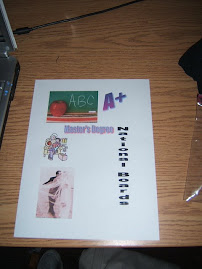
For my Mirror of Erised, I used clip-art to show you what I desire most in life. I have an A+ on there because I want to make good grades for the remainder of my time here at Appalachian, especially since all these upcoming classes have things to do with my major. The chalkboard is to show that I want to be a teacher in my own classroom one day, with a chalkboard where I can teach my students. One also sees "Master's Degree" and "National Boards" on there because these are two things that I really want to achieve during my teaching career. I definitely want to get married one day to the love of my life, whenever that may be. This is why there is a picture of a couple getting married on my mirror. The storyteller is to represent the fact that I want kids of my own one day. I want to be able to sit down with them and tell them stories, just like the lady is doing in this picture. Through this mirror one can see all the desires of my heart and what I want to happen for me one day.
Sunday, April 13, 2008
Harry Potter Censorship Issues
I agree that there are many thematic issues present in Harry Potter. The one that touched me the most is the power of love. I loved how the reason that Quirrell/Voldemort could not touch Harry was because his mother's love is what protected him in the first place. Voldemort tells Harry that the only reason his mother died was because she tried to protect her son. I think Neville Longbottom showed loyalty and courage whenever he tried to go find Harry to tell him that Malfoy knew about the dragon and was going to tell the professors. He could have gotten in lots of trouble but he decided he needed to help his friends. Harry's desire was to get that stone before the stone was taken by the "evil" power. When he looked in the Mirror of Erised, he desired this stone so the stone magically appeared in his pocket. Harry's determination also was displayed whenever Harry, Ron, and Hermione went through the trapdoor to find the stone. Harry was going to do whatever it took to get that stone. He went through fire and drank the potion and made sure his friends were safe. He also was determined that Voldemort was not going to hurt him or his friends. Harry was always forced to break the rules and rebel so he could keep up with Malfoy just because he despised him so much. For example, the incident when the students were not supposed to fly while the teacher wasn't there, but Malfoy tempted Harry and off they went! He also snooped around a lot whenever he felt that Snape was up to something and was trying to steal the stone.
Subscribe to:
Posts (Atom)