Title: "Baba Yaga and Vasilisa the Brave"
Author: Marianna Mayer
Illustrator: K.Y. Craft
Publisher: Morrow Junior Books, 1994
Genre: Fairy Tales, Multicultural
Grade: 2-3
Deep in the forest lived Baba Yaga, an ancient, terrible woman who ate humans. At the edge of this forest lived Vasilisa, her stepmother, and her two stepsisters. Vasilisa had to do all the chores around the house. The stepmother wanted Vasilisa out of the house so badly that she decided to cast a spell that there could not be any light at their house. To get light Vasilisa had to go to Baba Yaga's house and ask for some light. When she asked Baba Yaga for light, she told her she would help her but first Vasilisa had to help Baba Yaga around the house. If Vasilisa didn't complete these tasks then she would be eaten. The doll helped Vasilisa do all the tasks. Finally, Baba Yaga gave Vasilisa a lighted skull to take back to her stepmother and stepsisters. When Vasilisa got the skull home, it came to life and cast out flames that engulfed the two stepsisters and her stepmother. Vasilisa left the house and found an old woman who had no children to live with. She spun some fabric for the woman to show a token of her gratitude. The woman took the fabric to the Tzar and introduced Vasilisa to him. The Tzar and Vasilisa fell in love and got married.
I had never heard this Russian version of Cinderella. I really enjoyed it. I liked how it was not the traditional version where she lost her slipper, but instead this time she gives a piece of fabric away and that's how the tzar falls in love with her. The font in this book really gave me the eerie feeling that something bad was going to happen during the story. The illistrations were very life like, especailly the illistrations of the three different horses. Craft used watercolors, gouache, and oil for these full-color illustrations. The illistrations of Baba Yaga were very revealing that she was an old, creepy looking lady.
I would use this book in my classroom to compare it to other versions of Cinderella. I would have my students read the different versions of Cinderella and then have them to compare each of them to another. My students could do a venn-diagram if they wanted, or for older kids they could do an "I Poem For Two Voices" like I did. I could also use this book to talk about the Russian culture so the students could have some background for this version of the fairy tale.
Showing posts with label Fairy Tales. Show all posts
Showing posts with label Fairy Tales. Show all posts
Saturday, March 29, 2008

Yeh-Shen: A Cinderella Story from China
Title: "Yeh-Shen: A Cinderella Story from China"
Author: Ai-Ling Louie
Illustrator: Ed Young
Publisher: Puffin Books, 1982
Genre: fairy tale, multicultural
Grade: K-2
"Yeh-Shen" is the Chinese version of Cinderella, and is believed to have been the first Cinderella tale. Yeh-Shen is a little girl who has to live with her stepmother and her stepsister because her mother died. Because Yeh-Shen is much prettier than Stepmother's real daughter so she gives Yeh-Shen all the worst chores. Yeh-Shen's only friend is the fish so her stepmother stabs the fish. An old man appeared and told Yeh-Shen that the fish bones were magic and if she would kneel before them, she would receive her heart's desire. Yeh-Shen ends up going to the Festival but on her way home she loses one of the slippers. The King has the slipper placed in the middle of the Pavilion so every lady that comes through tries on the slipper. No one can wear it! Then Yeh-Shen shows up in the night and sneaks up and tries it on and sneaks it back home. The King goes to Yeh-Shen's house and they get married!
I had never heard this version of Cinderella before. I really enjoyed it though. I loved the illustrations that Ed Young included in this book. Ed Young has a very similar method of his illustrations that he put in "Lon Po Po." In "Lon Po Po" Young has a picture of the wolf in all the pictures. He also has most of the pages divided into different sections. This is the same in "Yeh-Shen." In the cover of "Yeh-Shen" you can see a picture of the fish and its fish scales on her body. On every page throuhout the book there is a picture of the fish. Some pictures the fish is easier to see than in others. Some of them you really have to search and look carefully at the picture to find the outline of the fish. I also think that Young divides his pictures up so the reader can look at each illistration carefully and see what is going on in the story. I think Young used watercolors to illustrate this book.
I would definitely use this book in my classroom one day. I would use it in a fairy tales unit. I think it would be interesting to have students read several different versions and have them to do a Venn-Diagram, or have older students to do a "I Poem with Two Voices." I also think it would be neat to have my students to compare "Yeh-Shen", the first Cinderella tale, with a more recent Cinderella tale like the Disney version or one of the newer ones. I think this would also be an ideal time to teach students about the different cultures. For example, we learn in "Yeh-Shen" that the Chinese have festivals to go find their future mates.
Author: Ai-Ling Louie
Illustrator: Ed Young
Publisher: Puffin Books, 1982
Genre: fairy tale, multicultural
Grade: K-2
"Yeh-Shen" is the Chinese version of Cinderella, and is believed to have been the first Cinderella tale. Yeh-Shen is a little girl who has to live with her stepmother and her stepsister because her mother died. Because Yeh-Shen is much prettier than Stepmother's real daughter so she gives Yeh-Shen all the worst chores. Yeh-Shen's only friend is the fish so her stepmother stabs the fish. An old man appeared and told Yeh-Shen that the fish bones were magic and if she would kneel before them, she would receive her heart's desire. Yeh-Shen ends up going to the Festival but on her way home she loses one of the slippers. The King has the slipper placed in the middle of the Pavilion so every lady that comes through tries on the slipper. No one can wear it! Then Yeh-Shen shows up in the night and sneaks up and tries it on and sneaks it back home. The King goes to Yeh-Shen's house and they get married!
I had never heard this version of Cinderella before. I really enjoyed it though. I loved the illustrations that Ed Young included in this book. Ed Young has a very similar method of his illustrations that he put in "Lon Po Po." In "Lon Po Po" Young has a picture of the wolf in all the pictures. He also has most of the pages divided into different sections. This is the same in "Yeh-Shen." In the cover of "Yeh-Shen" you can see a picture of the fish and its fish scales on her body. On every page throuhout the book there is a picture of the fish. Some pictures the fish is easier to see than in others. Some of them you really have to search and look carefully at the picture to find the outline of the fish. I also think that Young divides his pictures up so the reader can look at each illistration carefully and see what is going on in the story. I think Young used watercolors to illustrate this book.
I would definitely use this book in my classroom one day. I would use it in a fairy tales unit. I think it would be interesting to have students read several different versions and have them to do a Venn-Diagram, or have older students to do a "I Poem with Two Voices." I also think it would be neat to have my students to compare "Yeh-Shen", the first Cinderella tale, with a more recent Cinderella tale like the Disney version or one of the newer ones. I think this would also be an ideal time to teach students about the different cultures. For example, we learn in "Yeh-Shen" that the Chinese have festivals to go find their future mates.
Sunday, March 16, 2008
"The Three Little Pigs"
Title: "The Three Little Pigs"
Author and Illustrator: Steven Kellogg
Publisher: Morrow Junior Books, 1997
Genre: Traditional Literature
Grade: 2-3
In this version of the three little pigs, Serafina, the pig's mother, decides to open up a waffle business. Her three sons, Pete, Percy, and Prudence, work with her until their graduation day when their mother turns the business over to them. The three pigs built their houses, one of straw, one of log, and the other of brick. The wolf, Tempesto, blew down Percy's house and Percy went running to Pete's cabin. When Tempesto came to the log cabin, the wolf blew it down and the two pigs run to Prudence's house. Tempesto decides to climb down the chimney, but when he gets to the bottom he finds a waffle iron, so they put Tempesto into a taxi and sent him to the Gulf of Pasta.
This was a completely different take on The Three Little Pigs from what I have been use to hearing. This was an interesting story! The illustrations help the students see exactly what is going on. These particular illustrations are done with colored inks, watercolors, and acrylics.
I would use this tale in my classroom for a traditional tale unit. I would do the same for this book as I did for "The Story of the Three Little Pigs." I would have them to do the venn-diagram comparing the two stories. I could also have my students to write their own story using this book as their guide.
Author and Illustrator: Steven Kellogg
Publisher: Morrow Junior Books, 1997
Genre: Traditional Literature
Grade: 2-3
In this version of the three little pigs, Serafina, the pig's mother, decides to open up a waffle business. Her three sons, Pete, Percy, and Prudence, work with her until their graduation day when their mother turns the business over to them. The three pigs built their houses, one of straw, one of log, and the other of brick. The wolf, Tempesto, blew down Percy's house and Percy went running to Pete's cabin. When Tempesto came to the log cabin, the wolf blew it down and the two pigs run to Prudence's house. Tempesto decides to climb down the chimney, but when he gets to the bottom he finds a waffle iron, so they put Tempesto into a taxi and sent him to the Gulf of Pasta.
This was a completely different take on The Three Little Pigs from what I have been use to hearing. This was an interesting story! The illustrations help the students see exactly what is going on. These particular illustrations are done with colored inks, watercolors, and acrylics.
I would use this tale in my classroom for a traditional tale unit. I would do the same for this book as I did for "The Story of the Three Little Pigs." I would have them to do the venn-diagram comparing the two stories. I could also have my students to write their own story using this book as their guide.
"The Story of the Three Little Pigs"
Title: "The Story of the Three Little Pigs"
Author: Joseph Jacobs
Illustrator: Lorinda Bryan Cauley
Publisher: G.P. Putnam's Sons, 1980
Genre: Traditional Tale
Grade: 2-3
This story is about a mother pig who sends her three sons off to fend for themselves. The first little pig went and bought some straw and built himself a straw house. The big bad wolf came up and blew the straw house down and gobbled up the pig. The wolf then went on to the second pig's house, which was made of furze, and destroyed it and gobbled up the big. The wolf then goes to the third pig in his brick house and asks the pig to go gather turnips and apples with him, but in both cases the pig was already gone and back home before the wolf came. The wolf then threatens to blow down the house but when he can't do that he decides to come down the chimney. The pig moves a pot of boiling water under the chimney, so the wolf falls in and the pig has wolf to eat.
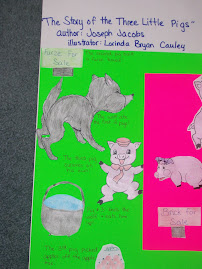
"The Three Little Pigs" has always been one of my favorite tales. This is actually the version I am most familiar with. I love the illustrations in this book. The colors that Cauley uses are so bright. There are no dull colors in the book. I also enjoy the pictures of the wolf blowing down the houses. Cauley does a great job of making it look like the wolf is right there with you blowing down the house.
I would use this story in my folktale unit. This would be a great book to read different versions of and have my students compare and contrast. I would have my students to read a number of different tales and have them to pick their favorite and do a venn-diagram of it. I could also read this story to my students and have them to write me a story with their own twists.
Author: Joseph Jacobs
Illustrator: Lorinda Bryan Cauley
Publisher: G.P. Putnam's Sons, 1980
Genre: Traditional Tale
Grade: 2-3
This story is about a mother pig who sends her three sons off to fend for themselves. The first little pig went and bought some straw and built himself a straw house. The big bad wolf came up and blew the straw house down and gobbled up the pig. The wolf then went on to the second pig's house, which was made of furze, and destroyed it and gobbled up the big. The wolf then goes to the third pig in his brick house and asks the pig to go gather turnips and apples with him, but in both cases the pig was already gone and back home before the wolf came. The wolf then threatens to blow down the house but when he can't do that he decides to come down the chimney. The pig moves a pot of boiling water under the chimney, so the wolf falls in and the pig has wolf to eat.
"The Three Little Pigs" has always been one of my favorite tales. This is actually the version I am most familiar with. I love the illustrations in this book. The colors that Cauley uses are so bright. There are no dull colors in the book. I also enjoy the pictures of the wolf blowing down the houses. Cauley does a great job of making it look like the wolf is right there with you blowing down the house.
I would use this story in my folktale unit. This would be a great book to read different versions of and have my students compare and contrast. I would have my students to read a number of different tales and have them to pick their favorite and do a venn-diagram of it. I could also read this story to my students and have them to write me a story with their own twists.
Subscribe to:
Comments (Atom)